
Description
Ah, the mid-2000s. A simpler time on the internet. MySpace was still ruling the social media scene, YouTube was a baby, and smartphones were more “dumbphone.”
Back then, the internet wasn’t just a place for memes and influencers—it was a digital Wild West, where quirky experiments could go viral and make someone wildly successful.
Enter The Million Dollar Homepage, a hilariously brilliant idea that proved even a college kid with a big dream and a knack for pixels could make internet history.
If you’re scratching your head thinking, “What’s this Million Dollar Homepage thing?” let me take you on a nostalgic journey to one of the quirkiest success stories the web has ever seen.
The Million-Dollar Brainwave
In 2005, Alex Tew, a 21-year-old student from England, was staring down the barrel of crushing student debt. Most of us would settle for part-time jobs or ramen noodles, but Alex decided to aim a little higher. He cooked up a plan so bizarre, so audacious, it was either going to crash and burn or make him a millionaire.
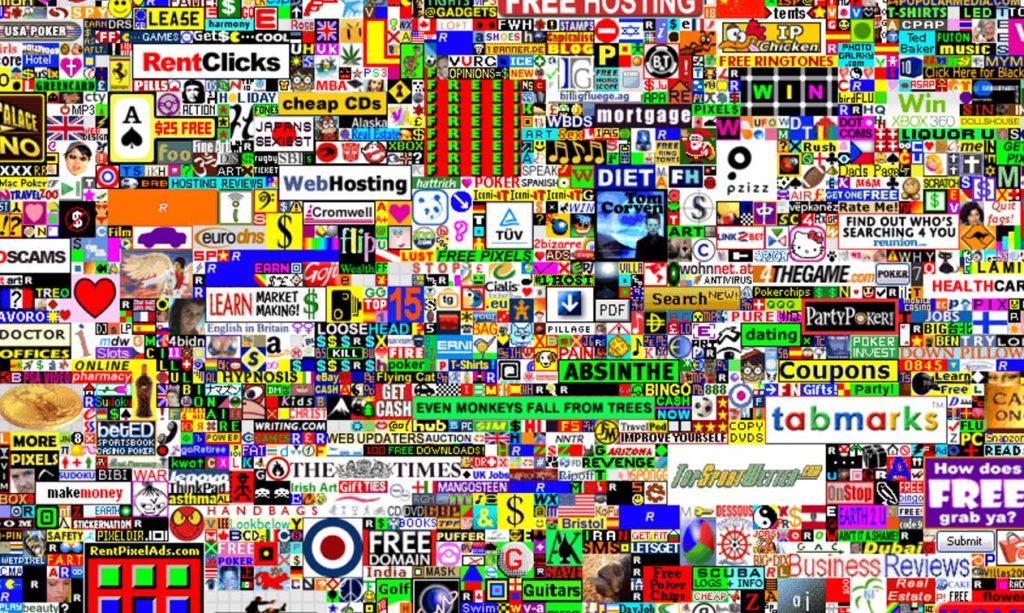
His idea? Sell a million pixels of online space on a single webpage for $1 each. Buyers would get to own a little piece of internet real estate, filling it with whatever image or ad they wanted.
The webpage, aptly named The Million Dollar Homepage, would look like a chaotic digital quilt of logos, graphics, and randomness. And people could click on the pixels to be whisked away to whatever site the buyer linked. It was like buying a square on a community patchwork but with a very internet twist.
Alex launched the site in August 2005 with a simple pitch: “Own a piece of internet history.” At the time, history was going for about the price of a latte.
A Pixel Party Goes Viral
At first, things were slow. Alex convinced friends and family to buy the first pixels, which netted him a modest $1,000. Then, as word spread, blogs, forums, and media outlets picked up the story, and The Million Dollar Homepage took off like a rocket. It became a viral sensation before we even had the term “viral sensation.”
Within weeks, businesses and individuals from all corners of the internet wanted a slice of the action. Everyone from online casinos to poker sites and even random joke businesses (looking at you, nose-picking website) jumped on board. It was chaotic, weird, and pure mid-2000s internet magic.
Let’s be real—some of the pixel ads were… questionable. There were glittery logos, random clip art, and some images that looked like they’d been made with MS Paint in five minutes. But that was part of the charm. The grid was a hot mess, and people loved it.
By January 2006, Alex had sold 999,000 pixels and raked in $999,000. The last 1,000 pixels went on eBay, fetching a cool $38,100. Grand total? $1,037,100. Not too shabby for a few pixels, huh?
Fame, Fortune, and Frustration
Of course, fame isn’t all pixel-perfect. Once The Million Dollar Homepage became a global sensation, Alex faced some headaches. Hackers came knocking, launching a DDoS attack in early 2006. They demanded a ransom, threatening to take the site offline. (Internet gangsters, right?) Alex stood his ground, and with the help of security experts, the site survived.
Meanwhile, critics chimed in with all kinds of opinions. Some called the project a genius work of art, others thought it was a goofy cash grab. The commercial chaos of the grid rubbed some people the wrong way, but for Alex, the goal was simple: pay for college and maybe buy himself a fancy dinner. Mission accomplished.
A Time Capsule of the Internet
The Million Dollar Homepage wasn’t just a quirky business idea—it was a snapshot of what the internet used to be. If you visit the site today (and yes, it’s still live), you’ll see the same patchwork of ads, logos, and randomness.
Some links are broken now, leading to defunct websites or long-forgotten businesses, but the digital chaos remains intact.
Back in 2005, the internet wasn’t dominated by sleek algorithms or polished content. It was a playground for weird ideas, messy experiments, and, yes, a lot of glitter text. The Million Dollar Homepage captures that era perfectly. It’s a chaotic, lovable museum of mid-2000s online culture.
Think about it: today, ad space is sold in milliseconds by supercomputers, targeted with creepy precision. Back then, people were just buying random blocks of pixels and crossing their fingers. Kind of refreshing, right?
Where’s Alex Now?
You’d think after making over a million dollars, Alex would have just kicked back and retired at 21. Nope. Instead, he used his entrepreneurial chops to start new projects. His biggest hit since The Million Dollar Homepage? Calm, the meditation and sleep app that’s helped millions of people chill out. Ironically, the guy who created one of the loudest, busiest web pages went on to create an app for peace and quiet. Talk about range.
As for The Million Dollar Homepage, it’s become a piece of internet lore. People still visit it, marveling at its chaotic charm and reminiscing about the early days of the web. For Alex, it’s a testament to the power of a simple idea executed at the right time.
Lessons from the Pixel Craze
The Million Dollar Homepage wasn’t just a quirky success—it was packed with lessons about creativity and the power of the internet. Here are a few takeaways:
- Simple ideas can be game-changers. You don’t need a billion-dollar tech breakthrough. Sometimes, a good idea and solid execution are enough.
- Timing is everything. The Million Dollar Homepage thrived because it hit the internet at the perfect moment when people were hungry for novelty.
- The internet loves weird. If you can make people laugh, scratch their heads, or feel part of something unique, they’ll rally behind you.
A Pixelated Legacy
Looking back, The Million Dollar Homepage feels like the perfect symbol of its time. It was chaotic, creative, and undeniably fun. For those of us who remember its rise, it’s a reminder of a younger, quirkier internet—an internet where a college student could dream up something outrageous, throw it online, and make a million bucks.
And for those who missed it? Well, the site’s still there, waiting for you to take a peek. It’s a blast from the past, a digital time capsule, and a reminder that even in today’s polished online world, there’s still room for crazy ideas.
So here’s to The Million Dollar Homepage: the internet’s wildest, wackiest, and most pixelated success story.
Long live the pixels!
Recommended Games






playgearz - Free Online Games
playgearz is a portal offering hundreds of online games accessible for free on your browser, playable immediately and without installation. On all media, computer, mobile or tablet, and wherever you are, you can play the best free games on the web. Each title is carefully selected and several times a week new games are offered to you. Whether you have 5 minutes to spend, at school, at work, or long hours to have fun, you will find on playgearz entertaining games classified by category for easy and intuitive navigation.
About our games:
We offer many games in all possible genres: action games, adventure games, puzzle games, sports games, but also two-player and online multiplayer games. playgearz became known thanks to its fighting games category which offers intense titles and many challenges. Multiplayer games are also very popular, they have gathered a large passionate community in search of ever more intense challenges. Another popular category is .io Games represented by the most renowned of them, Skribbl.io, a phenomenon game which brings together thousands of players who love to challenge each other online. 2 player games category is also very popular because it offers fun titles to play with a friend on the same computer. Games like G-Switch 3, Basketball Legends or Rooftop Snipers will give you unforgettable moments of fun.
About playgearz:
playgearz is a free games site created in 2013 which has since offered you the opportunity to easily and instantly discover the best online browser games on the web. Our objective is to provide a site accessible with intuitive navigation to play all the best online games. The site also offers a community space where members can share their gaming experiences, make friends and discuss about their gaming passion. playgearz is an internet portal published by SnokiGames, a sole proprietorship based in France. For more information, you can consult our "Privacy Policy" and "Terms of Use" sections below.
- Privacy Policy
- Terms of Service
- Copyright © 2025 playgearz. All rights reserved.
Comments on "Blast from the Past: The Million Dollar Homepage" :