
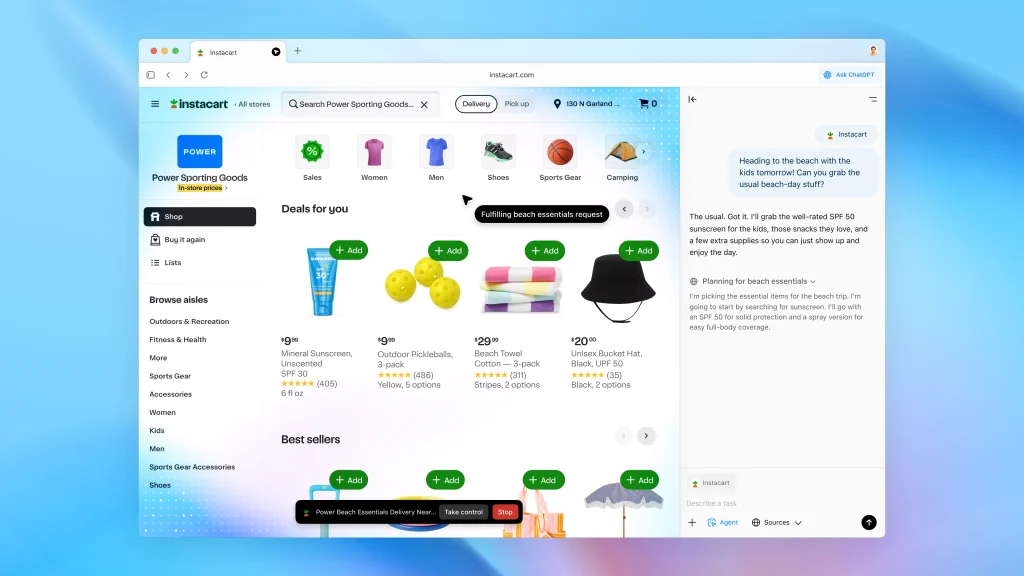
Description
There’s a quiet revolution happening in the one piece of software you use every single day but rarely think about—the browser. Chrome, Safari, Firefox—they’ve been our windows to the web for decades. But now, something seismic is happening.
A new species of browser is emerging: the AI browser. And it’s not just changing how we browse—it’s redefining what it means to use the internet at all.
Browsers Are Becoming Minds
Once upon a time, browsers were dumb. They showed you what you asked for, nothing more. You typed, they fetched. But AI browsers—ChatGPT Atlas, Arc Search, Perplexity, Opera with Aria, and even Microsoft’s Edge Copilot—are evolving into thinking companions.
They don’t just load a webpage; they decide what you actually wanted from it. Search for “best hotels in Kyoto,” and instead of a Google results page, you get an instant summary, itinerary, map, and maybe even a recommended flight. You didn’t browse—you delegated.
This shift is massive. The traditional search-browse-click loop—the backbone of the internet economy—is crumbling. Why wade through 20 SEO-optimized listicles when your browser can distill the web into an answer? But that convenience hides a darker tradeoff.
The Death of the Open Web
AI browsers are the next logical step in the “enshittification” of the internet. When your browser summarizes pages for you, it’s no longer the web you’re seeing—it’s the browser’s interpretation of it. You’re not reading human expression; you’re reading machine compression.
That means the web as a creative ecosystem—where independent creators, designers, and journalists publish for a human audience—is quietly dying. AI browsers flatten nuance into “key points.” They steal traffic without attribution. They turn websites into fuel for their own intelligence, and users into passive consumers of algorithmic digest.
It’s not hyperbole to say that AI browsers could finish what social media started: the total collapse of independent publishing economics. If users stop visiting actual sites, how do creators survive?
The Illusion of Personalization
AI browsers sell the fantasy of intimacy: “We know you. We’ll filter the web for you.” But personalization is a euphemism for manipulation. Your browser will know your habits, interests, biases, and emotional tone—then feed you information calibrated to keep you “satisfied.” That’s not browsing—it’s conditioning.
And once the browser becomes the mediator of truth, you no longer control what you see. The web ceases to be an open network and becomes a personalized hallucination—your own algorithmic bubble, curated by whatever model your browser vendor happens to use this quarter.
Designers, Beware: The Canvas Is Shifting
For web designers, this is an extinction-level event. What happens when your beautifully crafted website never gets seen—only summarized? When your microinteractions, motion design, and layout hierarchy are stripped down to bullet points by a large language model?
The browser was once our canvas. Now it’s becoming a black box.
Designers will need to shift from visual design to information design for machines. Metadata, structured data, and clarity of intent will matter more than color palettes or CSS animations. We’ll be designing for readability by AI, not just humans.
In a twisted way, this is the ultimate return to the origins of the web: clean, semantic information exchange. But it’s also the death of creativity as interface.
The Economic Fallout
AI browsers threaten not just aesthetics, but economics. Google’s empire relies on you clicking results. If browsers like Arc or Perplexity intercept those clicks with AI summaries, the ad-based web implodes. No traffic, no revenue, no ecosystem.
And then what? The browsers themselves will charge subscriptions. The “web” will become tiered—basic access for free, intelligent browsing for those who pay.
We could see the rise of “AI paywalls,” where models trained on your data are used to gatekeep your own preferences back to you.
The Fragmentation of Truth
AI browsers don’t agree with each other. Ask the same question in Arc, Copilot, and Perplexity—you’ll get different “facts.”
Each browser is training on different data, applying different ranking heuristics, and enforcing different values. This means truth becomes proprietary. Your worldview will depend on which browser you use.
It’s the new tribalism of the digital age: Chrome users vs. Arc users vs. Perplexity users. Not based on brand loyalty, but on epistemology.
The Philosophical Endgame
The browser is no longer a window—it’s a mirror. It doesn’t show you the world; it shows you a version of the world optimized for your attention. The question isn’t, “What can AI browsers do?” It’s, “What will they choose to hide?”
We’re witnessing the collapse of the human-web handshake. Once, we asked questions and discovered meaning. Now, we’re being answered before we even form the question.
And that should terrify us.
Recommended Games








playgearz - Free Online Games
playgearz is a portal offering hundreds of online games accessible for free on your browser, playable immediately and without installation. On all media, computer, mobile or tablet, and wherever you are, you can play the best free games on the web. Each title is carefully selected and several times a week new games are offered to you. Whether you have 5 minutes to spend, at school, at work, or long hours to have fun, you will find on playgearz entertaining games classified by category for easy and intuitive navigation.
About our games:
We offer many games in all possible genres: action games, adventure games, puzzle games, sports games, but also two-player and online multiplayer games. playgearz became known thanks to its fighting games category which offers intense titles and many challenges. Multiplayer games are also very popular, they have gathered a large passionate community in search of ever more intense challenges. Another popular category is .io Games represented by the most renowned of them, Skribbl.io, a phenomenon game which brings together thousands of players who love to challenge each other online. 2 player games category is also very popular because it offers fun titles to play with a friend on the same computer. Games like G-Switch 3, Basketball Legends or Rooftop Snipers will give you unforgettable moments of fun.
About playgearz:
playgearz is a free games site created in 2013 which has since offered you the opportunity to easily and instantly discover the best online browser games on the web. Our objective is to provide a site accessible with intuitive navigation to play all the best online games. The site also offers a community space where members can share their gaming experiences, make friends and discuss about their gaming passion. playgearz is an internet portal published by SnokiGames, a sole proprietorship based in France. For more information, you can consult our "Privacy Policy" and "Terms of Use" sections below.
- Privacy Policy
- Terms of Service
- Copyright © 2025 playgearz. All rights reserved.
Comments on "The Coming War of AI Browsers: Why the Web Will Never Be the Same Again" :